


Social Wall Sponsorship That Turns Engagement Into Revenue
Published on September 28, 2026
Your social wall already does a lot of work at your event, and a social wall sponsorship can turn that engagement into revenue. It pulls in attendee posts, keeps the room feeling alive, and gives people something to look at between sessions. But when budget discussions roll around, a “nice engagement feature” and things that don’t drive revenue are the first things on the chopping block. A revenue generating line item is usually safe. So the smartest move you can make is to stop treating your social wall as a cost and start selling it as a sponsorship so it can have a provable ROI.
This guide walks sponsorship sales teams and meeting planners through exactly how to do that. You’ll learn how to price it, package it, pitch it, and answer the one objection that always comes up. By the end, you’ll have a sponsored social wall that pays for itself and then some.
Start With a One-Page Profit and Loss
Before you sell anything, you need to know two numbers: what the wall costs you, and what similar organizations charge sponsors for it. When you put those side by side on a single page, the case makes itself.
The cost side is simple. An Everwall event social wall starts at $49 per event day for self-service, and full-service packages that include custom design run higher. Whatever tier you pick, you’ll have one clear number for what the wall costs you to run.
The revenue side is where it gets interesting. Sponsorship isn’t priced like a software subscription. It’s priced on what a sponsor’s brand exposure is worth during your event. When you look at what peer organizations put in their sponsorship prospectus documents, digital and screen-based sponsorships regularly sell for thousands of dollars, often bundled with other perks.
Here’s a simple version of what that one page might look like:
| Line item | Amount |
|---|---|
| Cost to run the social wall | What you pay Everwall + any related costs for screen rental |
| Sponsorship sold to a partner | Anchored to your attendance and screen time |
| Net revenue | Sponsorship minus cost |
When your finance team sees a positive number in that bottom row, the conversation goes much smoother. You’re no longer defending an expense, you’re presenting a profit.
Building Your Social Wall Sponsorship Package
A logo slapped on a screen is not a package. Sponsors have seen that a thousand times and they know what it’s worth, which is not much. What you want to sell is a set of clear deliverables that a sponsor can point to and measure.
Here’s what a strong social wall sponsorship package includes:
- Guaranteed logo rotations. The sponsor’s branding appears on the wall on a set schedule, not whenever there happens to be a gap. You promise a specific number of appearances per hour, and you deliver it.
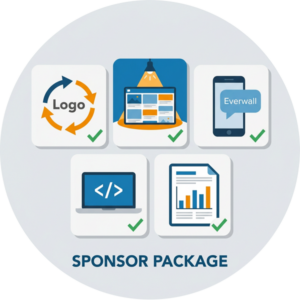 Prime placement moments. The keynote, the opening reception, the awards ceremony. These are the times the most eyes are on the screen. Reserve them for your sponsor and charge accordingly.
- Branded content prompts. When you ask attendees to post, you can frame the prompt around the sponsor. “Share your favorite session, brought to you by [Sponsor].” That puts the sponsor inside the attendee’s own posts, not just next to them.
- A website embed. Every Everwall social wall includes the ability to embed it on your website or event app at no extra cost. That means another opportunity to show the sponsor’s branding, reaching people who never set foot in the room.
- A post-event report. After the event, you hand the sponsor a document showing exactly how many posts appeared, how many people participated, and how far the content reached alongside a report showing how often their logo, overlays or videos were shown on the wall. More on this below, because it’s the part that closes deals.
When you combine these into a single named tier, you’ve built something a sponsor can say yes to. Each item is a promise you can keep and a promise they can see.
Pricing Your Social Wall Sponsorship
The most common mistake is pricing your social wall sponsorship based on what the wall costs you. Don’t do that. Price it based on what the sponsor gets.
Two factors drive the value:
Attendance
More people in the room means more eyes on the screen. A sponsorship at a 300-person regional meeting is worth less than the same sponsorship at a 3,000-person national conference. Use your confirmed attendance number as your starting anchor.
Screen time
A social wall is not a static banner. It runs for the entire event, cycling content in real time, with the sponsor’s branding appearing again and again. That dwell time is the whole point. Add up the hours your wall is live across all your screens and use that as your second anchor.
Once you have those two anchors, tier your offering. A simple three-tier structure works well:
- Presenting sponsor. One partner owns the wall. Their branding is on it the entire event, they get the prime placement moments, and they’re named in the post-event report. This is your top price.
- Supporting sponsor. Two or three partners share rotations. Each gets guaranteed appearances but not exclusivity. Priced in the middle.
- Contributing sponsor. A larger group gets logo rotations only, no prime moments. Your entry-level tier.
Tiering does two things. It lets sponsors of different sizes buy in, and it makes your top tier look like the obvious choice for the partner who wants to stand out.
The Pitch: Dwell Time Beats a Logo on a Banner
When you sit down with a sponsor, you’re competing against every other sponsorship option on your prospectus. The printed banner. The tote bag. The lanyard. Your job is to explain why the social wall is worth more.
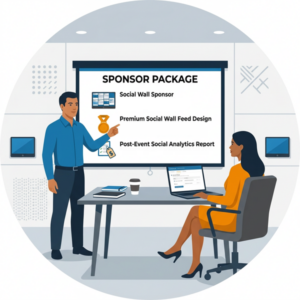 Here’s the core of the pitch:
“A banner sits in one spot, and people walk past it once or twice. Our social wall is on the main screens all day, and your brand appears on it again and again while attendees are actually looking. During the keynote, when every seat is full and every phone is out, your logo is on that screen. And because attendees are posting to the wall themselves, your brand shows up right next to real content people care about, not next to advertising they’ve learned to ignore.”
That’s the whole argument. A banner buys a location. A sponsored social wall buys attention over time, in the moments that matter most, sitting next to content the audience actually wants to see. When a sponsor understands that difference, the price starts to feel reasonable.
Handling the “Engagement Is Hard to Prove” Objection
Every sponsor asks some version of this: “How do I know it worked?” It’s a fair question, and it’s the reason a lot of engagement sponsorships fall apart. If you can’t prove the value, the sponsor won’t renew, and a one-time sale is a weak business.
This is where a real reporting tool matters. Everwall tracks the numbers that answer the question directly:
- Post volume. How many posts appeared on the wall during your event.
- Reach. How many people the content potentially got in front of, both in the room and online through the website embed.
- Participants. How many individual people posted, which shows the sponsor how many real humans were involved.
- Displayed time and counts. How many times and how much overall time their logo, and image or video overlays were shown on the screens.
When you hand a sponsor a post-event report with those numbers, “engagement is hard to prove” stops being an objection. You’ve proven it. And a sponsor who sees hard numbers is a sponsor who signs up again next year, which is how a single sale becomes a renewing revenue line. If you want ideas on framing those numbers, our piece on treating engagement as a revenue metric goes deeper.
The Sponsor-Funded Model for Smaller Organizations
Maybe you’re reading this thinking your event is too small to sell a big-ticket sponsorship. Here’s an approach that works even then: let the sponsor pay for the whole thing.
The math is easy because the wall doesn’t cost much to run. A single sponsor covers the full cost of the social wall in exchange for their branding on it, and you pocket the difference or run the wall at no cost to your budget. You get an engaging feature for your attendees, the sponsor gets visibility, and your finance team sees a line item that costs the organization nothing.
For a small nonprofit, a local conference, or a school event, this is often the easiest sponsorship to sell. The ask is small, the value is clear, and the sponsor gets a genuine spot in front of your whole audience. If you’re new to landing partners, our guide on how to get sponsors for an event pairs well with this model.
Put It All Together
Here’s the sequence, start to finish:
 Build your one-page profit and loss so you know your cost and your target price.
- Package the deliverables: guaranteed rotations, prime placement moments, the website embed, and the post-event report.
- Anchor your price to attendance and screen time, then split it into tiers.
- Pitch dwell time and guaranteed visibility, not a logo on a banner.
- Close the “prove it” objection with real post volume, reach, and participant numbers.
- For smaller events, let one sponsor fund the entire wall.
Do this once, and you have a repeatable product you can sell at every event you run. The wall stops being something you justify and becomes something you sell.
That’s the difference that gets you through budget season. A “nice engagement feature” gets cut when money is tight. A “this makes us money” line survives. Sell a social wall sponsorship, and you land firmly in the second category.
Ready to build a sponsored social wall that pays for itself? Everwall’s event social walls come with everything you need to package, run, and report on a sponsorship, including the post-event numbers that keep sponsors coming back. Reach out and ask us for a sponsorship one-pager, and we’ll help you put a price on your wall before your next event.
Pretty good, right? Share this with your people.


