


Why You Should Treat Engagement as a Revenue Metric
Published on March 2, 2026

For years, event professionals have tracked engagement through likes, impressions, and follower counts. These numbers look good in reports, but they rarely connect to business outcomes. A post with 10,000 impressions tells you almost nothing about whether attendees found value in your event or whether they plan to return next year.
This is the problem with vanity metrics. They measure visibility without measuring impact. An attendee might scroll past your event hashtag dozens of times without ever feeling connected to your brand or community. Meanwhile, another attendee who posts one thoughtful comment and stays an extra hour at your event looking at exhibitor’s booth’s represents real business value that traditional metrics completely miss.
The gap between what we measure and what actually matters has kept engagement in the “nice to have” category for too long.
How Engagement Directly Affects Revenue
When you start connecting engagement to dollars, the picture changes completely. Three revenue streams depend heavily on how actively your audience participates.
 Sponsor ROI
Sponsors want proof their investment reaches real people. Passive attendance numbers only tell part of the story. When attendees actively engage through posts, comments, and shared content, sponsors see evidence of attention and interest.
A sponsor’s logo displayed on a screen has value. That same logo appearing on a screen that shows 500 attendee-generated posts that attendees keep walking up to to read has significantly more value because it shows genuine interaction and that sponsor’s logo gets seen. Event analytics that capture this participation give sponsors concrete data they can use to justify their spend.
Repeat Attendance
People return to events where they felt involved. According to Skift Meeting’s research, engaged attendees are substantially more likely to register for future events compared to passive observers. This makes sense: participation creates memory, and memory drives loyalty. Finding ways to get attendees to engage more will get you more future attendance.
Community Retention
Events increasingly serve as touchpoints within larger communities. Active engagement during events strengthens connections between attendees. These connections keep people invested in your organization throughout the year, not just during the three days of your annual conference.
Participation Matters More Than Visibility
Here is where many event strategies go wrong: they optimize for reach instead of involvement.
Consider two scenarios:
Scenario A: Your event hashtag generates 50,000 impressions from 200 posts, mostly from your own marketing team and a handful of speakers.
Scenario B: Your event hashtag generates 15,000 impressions from 800 posts, spread across hundreds of different attendees.
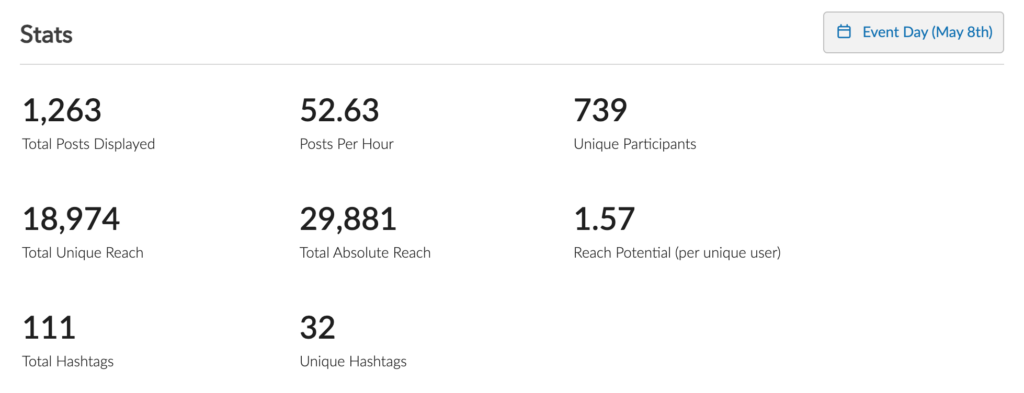
Scenario B represents healthier engagement even though the impression count is lower. Why? Because contribution signals genuine interest. When someone takes time to create content about your event, they are processing their experience and sharing it with their network. One of the reasons that we track the number of unique participants on your social wall at Everwall is specifically so you can see and track this information. The more unique participants you have, the healthier the engagement is for your event.
Interaction also builds loyalty in ways that observation cannot. The attendee who submits a photo to your social wall or responds to another participant’s post has made a small commitment to your event community. These micro-commitments add up over time.
Designing for participation rather than hoping for it requires the right tools. Platforms that capture structured participation through hashtag posts, direct submissions, or SMS make it easier to track these meaningful interactions. Everwall’s event social walls pull content from 15 different sources, including Instagram, LinkedIn, and SMS, giving attendees multiple ways to contribute while providing organizers with clear data on who participated and how.
Measuring Engagement Like You Measure Revenue
If engagement drives sponsor value, repeat attendance, and community retention, it deserves the same measurement rigor as ticket sales. This means moving beyond counting impressions toward tracking:
- Contribution rate: What percentage of attendees actively posted or submitted content? The (number of unique participants/total registered attendees that showed up)x100 will show you this.
- Engagement rate: Do you know how engaged people were on social media for your event? You can see the total number of posts and divide that by the unique participants to see the engagement rate (another stat that Everwall provides).
- Content quality: Did posts include substantive commentary or just generic check-ins?
- Interaction depth: How many attendees engaged with each other’s content versus only with official event posts?
- Time spent: How long did people stay engaged with participation opportunities?
These metrics connect directly to the revenue outcomes we discussed earlier. A high contribution rate signals strong sponsor value. Quality content indicates memorable experiences that drive repeat attendance. Peer-to-peer interaction suggests community building that extends beyond the event itself.
Real-time displays make this measurement visible during the event, not just in post-event reports. When organizers can see participation happening live on a social wall, they can adjust programming to encourage more of what’s working. For more on building this into your event strategy, see our guide on audience participation.
The Shift in How Events Are Evaluated
Forward-thinking organizations have already started treating engagement as a strategic KPI rather than a supplementary metric. This shift reflects broader changes in how businesses evaluate marketing and community investments.
The traditional approach looked like this:
- Host event
- Count attendees
- Survey for satisfaction
- Hope for renewals
The strategic approach looks different:
- Define engagement goals tied to business outcomes
- Design participation opportunities throughout the event
- Capture and measure engagement in real time
- Connect engagement data to sponsor renewals, attendee retention, and community growth
This second approach requires better tools and clearer thinking about what you want attendees to do, not just see. It also requires showing stakeholders why engagement metrics belong in executive dashboards alongside revenue figures.
When events become line items justified by engagement data rather than attendance estimates, the conversations with leadership change. You stop defending costs and start demonstrating returns.
Making Engagement Visible and Measurable
The practical challenge is capturing engagement in formats that translate to reports and presentations. Random social mentions are hard to quantify. Structured participation through specific hashtags, submission forms, or event-specific channels creates trackable data.
This is where thoughtful tool selection matters. Your conference engagement tools should make participation easy for attendees while generating the data you need for stakeholder conversations.
 A social wall displayed prominently at your event does double duty. It encourages participation by showing attendees that their contributions will be seen by the room. It also captures every submission in a format you can analyze later. When sponsors see their logos appearing on screens throughout your venue next to attendee-generated content causing people to walk up and read the screens, the value becomes undeniable. Tools like Everwall can also generate sponsor-focused reports, like the number of times their overlay was displayed or the amount of time it was shown on the screens—that means you can provide reports that can prove ROI to your sponsors.
For events with both in-person and remote audiences, these same tools extend engagement opportunities to everyone. Website embeds let virtual attendees participate alongside those on-site, expanding both the reach and the measurable impact of your engagement strategy.
What This Means for Your Next Event
Treating engagement as a revenue metric requires a mindset shift, but not necessarily a budget increase. It means asking different questions during planning:
- How will we measure attendee participation, not just attendance?
- What data will we show sponsors to prove their investment reached engaged audiences?
- How will we track whether engagement correlates with future registrations?
The tools exist. The frameworks exist. What often lacks is the organizational commitment to measure engagement with the same seriousness applied to revenue.
Events that make this shift gain competitive advantages in sponsor negotiations, attendee retention, and stakeholder support. They stop treating engagement as decorative and start treating it as measurable business value.
For a deeper look at connecting engagement to financial outcomes, explore our event ROI guide.
Ready to capture and measure engagement at your next event? Everwall’s event social walls display real-time content from 15 different sources while giving you the data you need to prove engagement value to sponsors and stakeholders.
Pretty good, right? Share this with your people.


