


Social Media ≠ Engagement (And Events Keep Confusing the Two)
Last Updated on January 21, 2026
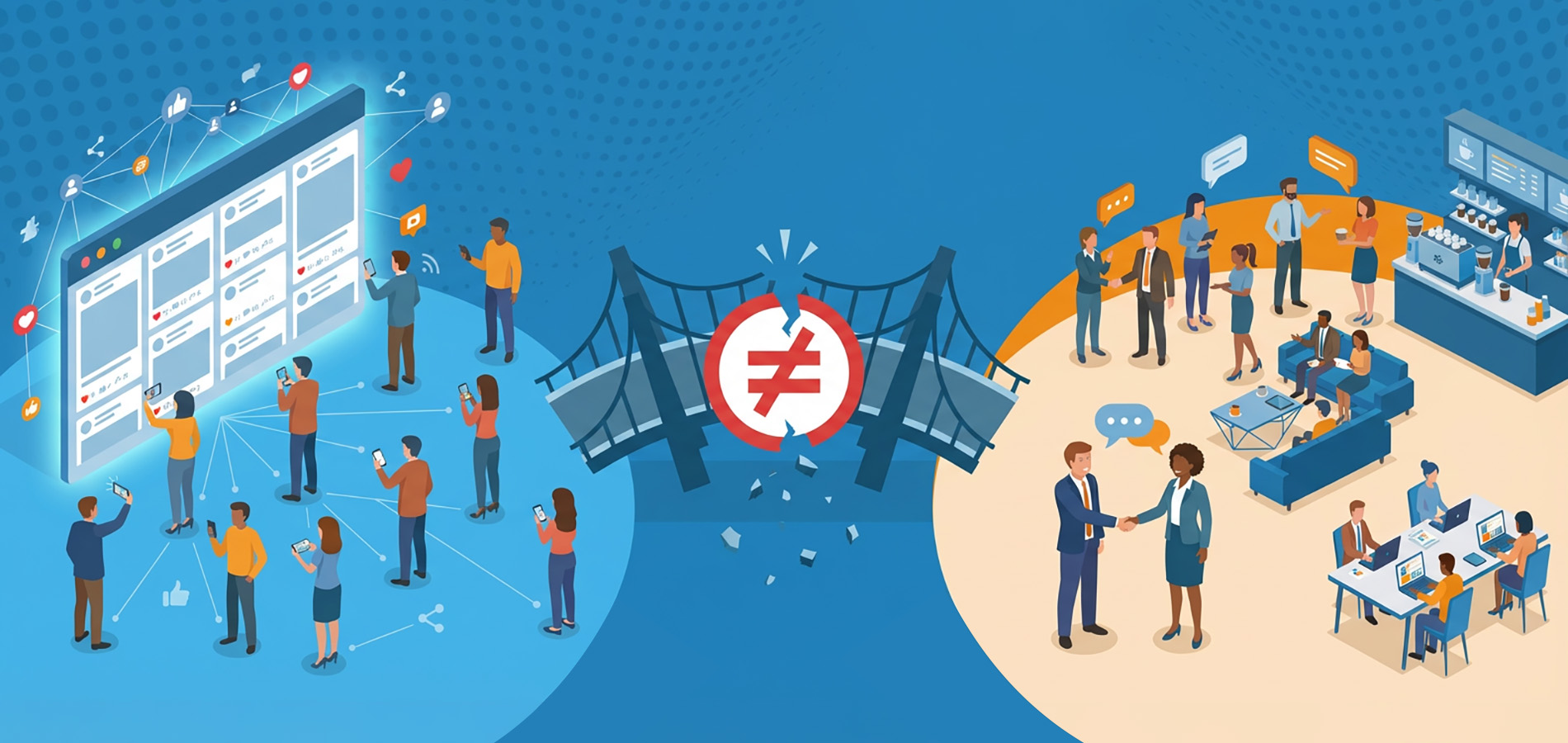
Here’s a scenario that happens at almost every conference, trade show, and corporate event: organizers put up screens showing a hashtag feed, encourage attendees to post, and then count the resulting social media activity as “engagement.” The more posts, the more successful the event seems.
But what if that math is completely wrong?
What if all those likes, shares, and hashtag mentions are measuring something entirely different from actual engagement? And what if the focus on social media metrics is actually excluding huge portions of your audience from participating at all?
The events industry has quietly accepted a flawed definition of engagement for years. It’s time to question that assumption. Because when we confuse visibility with participation, we end up designing events that look successful on paper but leave most attendees standing on the sidelines.
Social Media Activity Is Not the Same as Audience Engagement
But counting posts only tells you how many people performed publicly. It says nothing about how many people actually participated in your event’s experience.
 Think about the average conference session with 500 attendees. Maybe 30 people post something with the event hashtag during the keynote. That’s 6% of the room. What about the other 94%? Were they not engaged? Or were they simply not willing to post publicly on social media?
The problem is that event organizers often stop at the metric they can measure easily and assume it represents the whole picture. Social media engagement becomes a stand-in for overall event engagement, even though they’re measuring fundamentally different things.
Visibility tells you who wanted to be seen. Participation tells you who wanted to be involved. Those are not the same groups of people.
Why Social Media Participation Excludes Most of Your Audience
Social media works well for people who are comfortable sharing publicly, have active accounts on the right platforms, and happen to be paying attention when the algorithm decides to show their content. That’s a pretty narrow slice of any event audience.
Consider who gets left out:
People without social media accounts. Not everyone uses Instagram, X, or LinkedIn. Some attendees have privacy concerns. Others simply never signed up. According to Pew Research Center, about 30% of U.S. adults don’t use any social media platform at all. That’s a significant portion of potential participants who literally cannot engage through traditional hashtag campaigns.
People who don’t want to post publicly. Even among social media users, many people prefer to consume content rather than create it. Asking them to share thoughts publicly with their entire network is asking them to step outside their comfort zone. Most won’t.
People whose posts don’t get shown. Social media algorithms decide what content appears and what gets buried. Your attendee might post something thoughtful and genuine, but if the algorithm doesn’t favor it, that contribution disappears into the void. The attendee participated, but no one saw it.
People who find the process too complicated. Posting with a specific hashtag, logging into an app, crafting a message, and adding photos creates friction. Every extra step loses potential participants.
When your only pathway to engagement runs through social media, you’re building an event experience around the preferences of a small, self-selecting group. Everyone else watches from the outside.
The Difference Between Performance and Participation
Social media posts are inherently performative. When someone shares content publicly, they’re aware of their audience. They consider how they’ll be perceived by coworkers, friends, or professional contacts who might see the post. They craft their message accordingly.
Performance isn’t bad. It can generate authentic enthusiasm and extend your event’s reach. But it shouldn’t be confused with participation, which is about contributing, reacting, and being included in the experience.
Here’s how they differ:
Performance
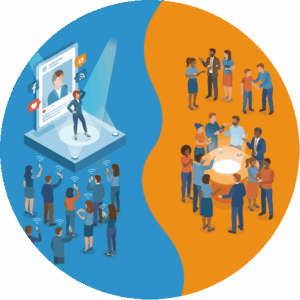 Requires a public platform
- Focuses on how the poster looks to others
- Filtered through personal brand considerations
- Limited to people comfortable with visibility
- Subject to algorithm distribution
Participation
- Can happen privately or publicly
- Focuses on being part of the moment
- Unfiltered and in-the-moment
- Open to anyone willing to contribute
- Reaches everyone in the room
A person who votes in a live poll is participating. Someone who submits a question anonymously is participating. An attendee who sends a photo directly to an event display without posting it to their personal feed is participating.
None of those actions require public performance. All of them create real event engagement.
The most effective event engagement tools make room for both. They give extroverts a platform to shine while creating pathways for everyone else to contribute without broadcasting to the world.
What Real Event Engagement Actually Looks Like
If social media metrics don’t capture true engagement, what does? Real participation shares a few characteristics that set it apart from surface-level activity.
Low Friction
The easier it is to participate, the more people will do it. Every additional step, from logging into an app to remembering a hashtag, creates a barrier. Real engagement tools remove as many barriers as possible. The best ones let people contribute in seconds without requiring accounts, downloads, or complicated instructions.
Inclusive by Design
Participation shouldn’t require that attendees have specific apps or feel comfortable with public posting. When you design engagement around multiple pathways, you capture input from a much wider range of people. Some will want to post on Instagram. Others will prefer sending a text message. Both should be able to participate equally.
Purposeful
Random activity isn’t the same as meaningful interaction. Engagement works best when it connects to your event’s goals. Are you trying to gather feedback? Celebrate attendees? Create networking moments? The tools and approaches you choose should support those specific purposes, not just generate generic activity.
Designed, Not Hoped For
This might be the most important distinction. Events that achieve real audience engagement don’t just make it possible to participate. They actively design participation into the experience. They prompt it, guide it, make it visible, and reward it.
Hoping people will engage spontaneously rarely works. Designing structured moments for interaction almost always works better.
Engagement Beyond Social Media Accounts
Here’s where things get interesting. What if you could capture all the energy and visual excitement of a social wall without requiring anyone to have a social media account?
Some audience engagement tools now support direct participation pathways. Attendees can submit photos, messages, or questions through a simple web form or text message. No Instagram account needed. No public posting required. The content appears on displays alongside social media posts, creating a complete picture of audience participation.
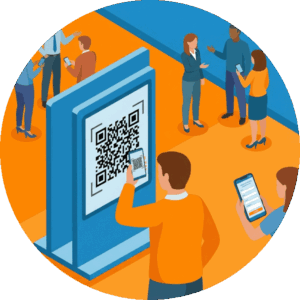 This approach fundamentally changes who can participate. The quiet attendee who never posts online can now share a photo from the session. The executive who refuses to use social media for personal reasons can still submit a question for the speaker. The international attendee who uses different platforms than your hashtag campaign supports can contribute through a universal web form.
Platforms like Everwall support this kind of non-social participation through features like Everwall Direct, which lets attendees submit content via web forms without any social media account. Combined with SMS submission and traditional hashtag aggregation, it creates multiple on-ramps for participation.
The result looks the same on screen. A vibrant display of attendee content, photos, messages, and reactions. But the audience that can contribute grows significantly.
Rethinking How We Measure Event Success
When events rely entirely on social media for engagement, they’re measuring what’s easy rather than what matters. Post counts become vanity metrics that tell an incomplete story.
A better approach measures participation across all channels. How many unique contributors did you have? What percentage of your audience submitted something? Did engagement stay consistent throughout the event or spike and drop?
These questions lead to more useful insights than raw hashtag counts. They tell you whether your event actually connected with people or just generated temporary social noise.
Consider tracking participation like this:
- Total unique contributors (across all input methods)
- Percentage of registered attendees who participated
- Geographic or demographic spread of participants
- Engagement patterns over time during the event
- Quality indicators like question depth or photo composition
This kind of measurement requires tools that aggregate multiple input sources into one view. A conference engagement tool that only counts social posts misses the bigger picture. One that combines social media, direct submissions, SMS, and other channels gives you actual data about how your audience engaged.
Designing Events for Participation
The shift from hoping for engagement to designing for it requires a different mindset. Instead of adding a hashtag as an afterthought, participation becomes part of how you structure the event experience.
What does this look like in practice?
Create specific prompts. Instead of “post with #OurEvent,” give people concrete reasons to participate. “Share your best takeaway from this session” or “Show us your conference view” gives attendees direction and purpose.
Make participation visible. When people see their contributions on screen, it validates their participation and encourages others. Social walls that display content in real-time create this visibility loop.
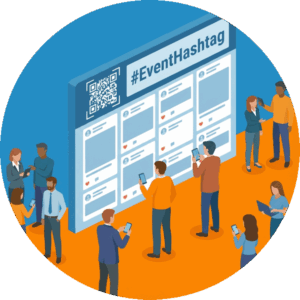 Remove barriers to entry. Offer multiple ways to participate. Social posting for those who want it, direct submission for those who don’t. SMS for people who find forms annoying. The more options, the fewer excuses for sitting out.
Build in moments for interaction. Schedule times during your event specifically for participation. Between sessions, during breaks, after keynotes. Structured windows work better than open-ended suggestions.
Acknowledge contributions. Thank people who participate. Feature standout contributions. Let attendees know their input matters and gets noticed.
The Future of Event Engagement
The events industry is slowly recognizing that social media metrics tell only part of the story. As more organizers prioritize inclusivity and genuine connection, expect to see participation models that welcome everyone, not just the socially active minority.
This doesn’t mean abandoning social media. Hashtag campaigns still generate reach, create shareable moments, and extend event impact beyond the venue. But they work best as one channel among several rather than the only pathway to participation.
The events that will stand out are the ones that ask better questions. Not “how many posts did we get?” but “how many people actually participated?” Not “did this trend on social media?” but “did our attendees feel included and connected?”
Are you designing engagement, or just hoping for it?
Ready to create event experiences that include your entire audience? Everwall’s event social walls support participation through social media, direct web submissions, and SMS, so everyone can contribute regardless of their social media preferences. See how designing for real engagement can change your next event.
Pretty good, right? Share this with your people.


